Circadian glossary
Definitions of the circadian science behind jet lag, shift work, peak performance, and circadian medicine — from zeitgebers to phase shifts.
Advanced sleep phase
A circadian pattern where sleep occurs earlier than typical social schedules.
Biological clock
Another term for the circadian clock that regulates daily physiological rhythms.
Blue light
Short-wavelength light that strongly influences circadian timing and can suppress melatonin.
Bright light therapy
A treatment that uses timed exposure to bright light to shift or stabilize the circadian rhythm.
Chronobiology
The scientific field that studies biological timing systems, including circadian rhythms and sleep-wake cycles.
Chronotype
An individual's natural preference for sleeping earlier or later, commonly referred to as an "early bird" or a "night owl."
Circadian adaptation
The process of adjusting circadian timing to a new schedule or environment.
Circadian alertness
Fluctuations in alertness during the day driven by circadian rhythms.
Circadian alignment
When the circadian clock is synchronized with sleep schedules, light exposure, and daily activities.
Circadian-based scheduling
Designing work schedules and routines that align with circadian biology.
Circadian clock
The internal biological timing system that coordinates circadian rhythms and aligns the body with the day-night cycle.
Circadian disruption
Chronic disturbance of the circadian system that can negatively impact sleep, health, and performance.
Circadian fatigue
Reduced alertness caused by circadian timing or misalignment.
Circadian health
Maintaining a stable circadian rhythm that supports sleep, metabolism, mood, and cognitive performance.
Circadian misalignment
When the circadian clock is out of sync with sleep timing or environmental cues, often due to shift work or jet lag.
Circadian optimization
Aligning sleep, light exposure, and behavior with circadian timing to improve performance and health.
Circadian performance rhythm
Daily fluctuations in cognitive and physical performance driven by the circadian clock.
Circadian phase
A specific point in the circadian rhythm cycle, such as biological morning, afternoon, evening, or night.
Circadian phase response curve (PRC)
A scientific model describing how light exposure at different times shifts the circadian clock.
Circadian rhythms
The natural ~24-hour biological cycle that regulates sleep, alertness, hormones, metabolism, body temperature, and many other physiological processes.
Circadian timing
The internal timing of biological processes within the circadian cycle.
Core body temperature rhythm
A daily pattern in body temperature that reflects circadian timing.
Cortisol rhythm
The daily cycle of cortisol levels that typically peak in the morning and decline throughout the day.
Delayed sleep phase
A circadian pattern where sleep occurs later than typical social schedules.
Dim light melatonin onset (DLMO)
A scientific marker used to determine when melatonin production begins in the evening.
Early bird
A person whose circadian rhythm naturally favors early sleep and wake times.
Entrainment
The process by which circadian rhythms synchronize with environmental signals such as light.
Homeostatic sleep pressure
The biological drive for sleep that increases the longer a person stays awake.
Infradian rhythm
Biological rhythms longer than 24 hours, such as menstrual cycles.
Intrinsically photosensitive retinal ganglion cells (ipRGCs)
Specialized cells in the eye that detect light and send signals to the circadian clock.
Jet lag
Jet lag is a temporary physical and mental condition caused by a misalignment between your circadian rhythms and a new time zone after crossing time zones faster than your body’s circadian clocks can adapt.
Light-dark cycle
The daily pattern of daylight and darkness that helps synchronize circadian rhythms.
Light exposure
The timing and intensity of light reaching the eyes, which strongly influences the circadian clock.
Light sensitivity of the circadian system
The circadian clock's responsiveness to different wavelengths and intensities of light.
Melanopsin
A light-sensitive photopigment in specialized retinal cells that signals light exposure to the circadian clock.
Melatonin
A hormone released by the brain in darkness that signals the body it is time to sleep.
Melatonin suppression
Reduction of melatonin production caused by exposure to light at night.
Night owl
A person whose circadian rhythm naturally favors later sleep and wake times.
Night shift
A work schedule that occurs during nighttime hours when the circadian clock promotes sleep.
Phase advance
A shift that moves the circadian rhythm earlier, enabling earlier sleep and wake times.
Phase delay
A shift that moves the circadian rhythm later, enabling later sleep and wake times.
Phase shift
A change in the timing of the circadian clock.
SCN
The SCN is the master circadian clock in the hypothalamus, keeping a ~24-hour rhythm synchronized to the light-dark cycle via the eyes.
Shift work
Employment schedules that occur outside typical daytime hours.
Shift work disruption
A circadian rhythm sleep disorder caused by work schedules that conflict with the circadian clock.
Shift worker
A shift worker is anyone whose work hours fall substantially outside the conventional daytime window (roughly 07:00–18:00), including night, early-morning, evening, or rotating schedules.
Sleep shifting
Sleep-wake cycle
The daily rhythm of sleep and wakefulness regulated by circadian timing and sleep pressure.
Social jet lag
Circadian disruption caused by differences between weekday and weekend sleep schedules.
Timeshifter jet lag app
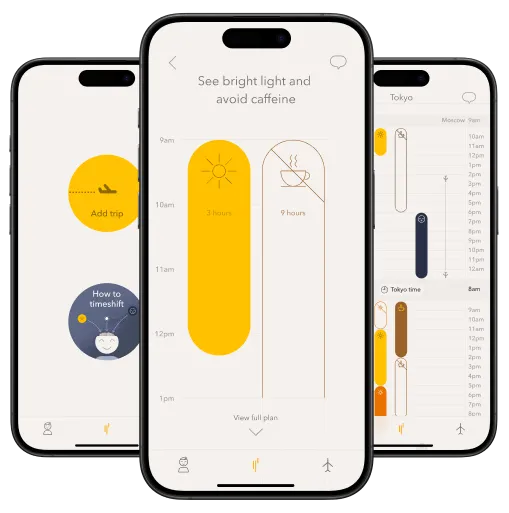
The most-downloaded jet lag app in the world (more than 1.7 million users). It's based on the latest sleep and circadian neuroscience.
Timeshifter shift work app
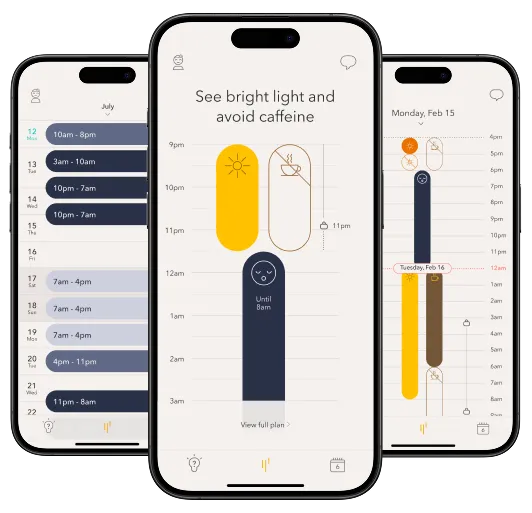
The #1 app for shift workers. It's based on the latest sleep and circadian neuroscience.
Ultradian rhythm
Biological cycles shorter than 24 hours, such as the stages of sleep.
Zeitgeber
An environmental cue that resets or synchronizes the circadian clock, with light being the most powerful.