Chronotype quiz

This free chronotype quiz uses the original Morningness-Eveningness Questionnaire (MEQ) by Horne & Östberg (1976): 19 questions in about 5 minutes that show whether you’re a morning lark, a night owl or in between.

Instructions

  1. Please read each question very carefully before answering.
  2. Answer ALL questions.
  3. Answer questions in numerical order.
  4. Each question should be answered independently of others. Do NOT go back and check your answers.
  5. All questions have a selection of answers. For each question select ONE answer only.
  6. Please answer each question as honestly as possible. Both your answers and the results will be kept in strict confidence.

1. Considering only your own “feeling best” rhythm, at what time would you get up if you were entirely free to plan your day?

2. Considering only your own “feeling best” rhythm, at what time would you go to bed if you were entirely free to plan your evening?

3. If there is a specific time at which you have to get up in the morning, to what extent are you dependent on being woken up by an alarm clock?

4. Assuming adequate environmental conditions, how easy do you find getting up in the mornings?

5. How alert do you feel during the first half hour after having woken in the mornings?

6. How is your appetite during the first half-hour after having woken in the mornings?

7. During the first half-hour after having woken in the morning, how tired do you feel?

8. When you have no commitments the next day, at what time do you go to bed compared to your usual bedtime?

9. You have decided to engage in some physical exercise. A friend suggests that you do this one hour twice a week and the best time for him is between 7.00–8.00 AM. Bearing in mind nothing else but your own “feeling best” rhythm how do you think you would perform?

10. At what time in the evening do you feel tired and as a result in need of sleep?

11. You wish to be at your peak performance for a test which you know is going to be mentally exhausting and lasting for two hours. You are entirely free to plan your day and considering only your own “feeling best” rhythm which ONE of the four testing times would you choose?

12. If you went to bed at 11.00 PM at what level of tiredness would you be?

13. For some reason you have gone to bed several hours later than usual, but there is no need to get up at any particular time the next morning. Which ONE of the following events are you most likely to experience?

14. One night you have to remain awake between 4.00–6.00 AM in order to carry out a night watch. You have no commitments the next day. Which ONE of the following alternatives will suit you best?

15. You have to do two hours of hard physical work. You are entirely free to plan your day and considering only your own “feeling best” rhythm which ONE of the following times would you choose?

16. You have decided to engage in hard physical exercise. A friend suggests that you do this for one hour twice a week and the best time for him is between 10.00–11.00 PM. Bearing in mind nothing else but your own “feeling best” rhythm how well do you think you would perform?

17. Suppose that you can choose your own work hours. Assume that you worked a FIVE hour day (including breaks) and that your job was interesting and paid by results. Which FIVE CONSECUTIVE HOURS would you select?

18. At what time of the day do you think that you reach your “feeling best” peak?

19. One hears about “morning” and “evening” types of people. Which ONE of these types do you consider yourself to be?

Your result

Thank you. Your answers have been saved.

Oops! Something went wrong while submitting the form.

What is a chronotype?

Your chronotype is your natural tendency to be active and alert earlier or later in the day. It reflects the timing of your circadian clock, the internal 24-hour clock that regulates sleep and wakefulness.

Read more about chronotypes >

About this quiz

This chronotype test uses the original Morningness-Eveningness Questionnaire (MEQ), published by James Horne and Olov Östberg in 1976. Its 19 questions ask when you prefer to sleep, wake up and perform at your best. In the original study, morning types reached the daily peak of their body temperature rhythm earlier in the day than evening types. Unlike shortened or adapted versions, this MEQ test keeps the original questions and scoring.

What your score means

MEQ scoreChronotype
70–86Definitely morning type
59–69Moderately morning type
42–58Neither type
31–41Moderately evening type
16–30Definitely evening type

Good to know

  • The questionnaire describes your preferred timing. It is not a diagnosis.
  • It was first validated in adults aged 18–32, and chronotype tends to shift with age.
  • Score cut-offs can differ between populations.
Jet lag is history.

The most downloaded and highest-⁠rated jet lag app in the world.

4.7/5 · 6,171 ratings
Best app for jet lag showing personalized jet lag plan
App for shift workers

The shift work app that improves sleep and alertness, personalized to your schedule.
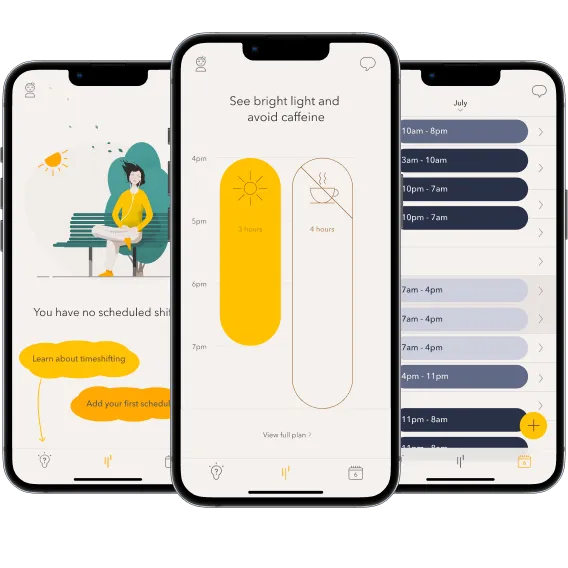
Timeshifter app for shift workers and night shifting

FAQ

What is the Morningness-Eveningness Questionnaire?

The Morningness-Eveningness Questionnaire (MEQ) is a 19-question self-assessment published by James Horne and Olov Östberg in 1976. It measures whether you are a morning type, an evening type or neither, based on when you prefer to sleep, wake up and perform at your best.

How is the chronotype quiz scored?

Each answer has a point value from the original questionnaire. The points are added up to a score between 16 and 86. Higher scores mean a stronger morning preference: 70–86 is definitely morning type, 59–69 moderately morning type, 42–58 neither type, 31–41 moderately evening type and 16–30 definitely evening type.

What is a good MEQ score?

There is no good or bad score. Your score shows whether your preferred timing for sleep and activity is earlier or later in the day.

How is this different from animal chronotype quizzes?

Animal-based quizzes use popular-science categories. This quiz uses the original scientific questionnaire and its published scoring, which researchers have used for decades to study chronotype.

Are my answers saved?

If you agree before you start, your anonymous answers and score are stored and may be used for research, as described in our Privacy Policy.

References

  1. Horne JA, Östberg O. A self-assessment questionnaire to determine morningness-eveningness in human circadian rhythms. Int J Chronobiol. 1976;4(2):97–110.
Shopping cart
Your basket is empty
Checkout
Discount code