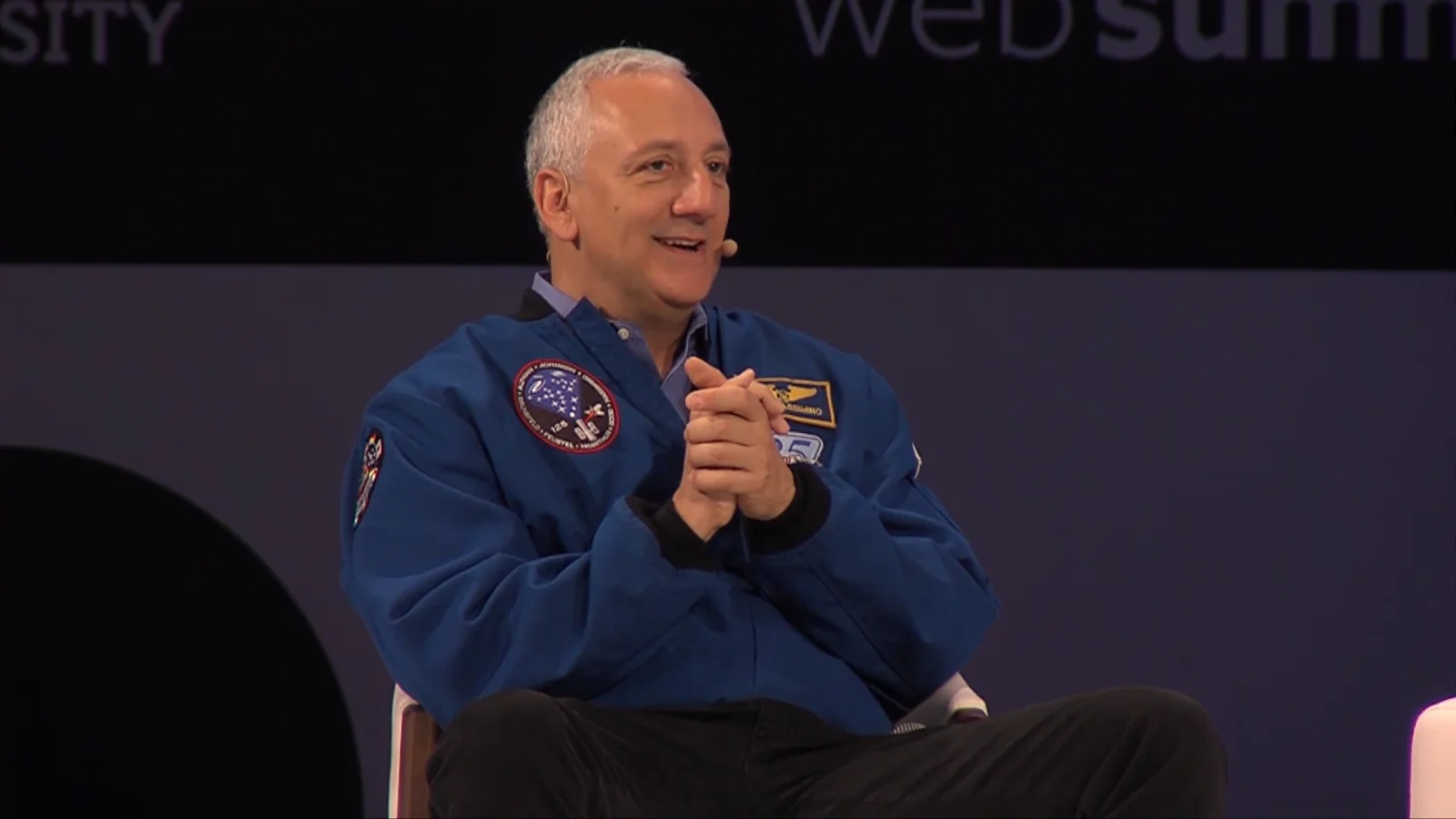
Timeshifting panel with NASA astronaut Mike Massimino at Web Summit 2018
The most downloaded and highest-rated jet lag app in the world.
Key moments
- 0:00 – Panel introductions
- 1:18 – What causes jet lag
- 3:05 – Who already uses this science
- 4:16 – Timeshifting in space: Hubble missions
- 7:42 – Why Timeshifter was founded
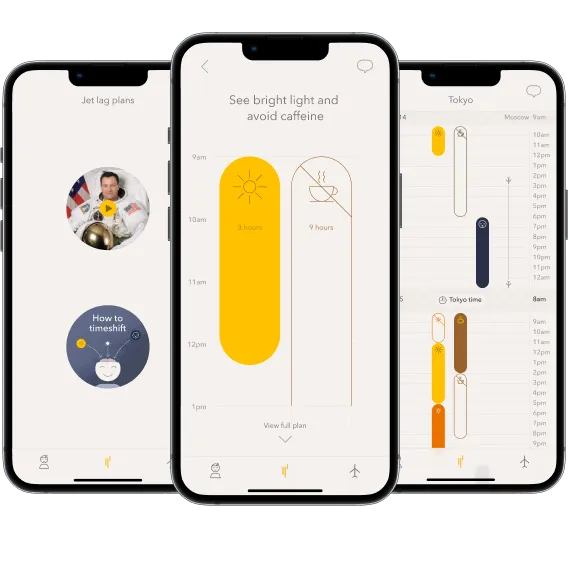
- 9:26 – How the Timeshifter app works
- 12:20 – How the travel industry is responding
- 14:07 – Why aren’t all astronauts tech investors?
- 17:48 – Reaching travelers through partnerships
- 19:39 – The future of circadian science and medicine
Transcript
Moderator: Great. So hello everyone, thank you so much for joining us today. We have a very distinguished panel for you. These three gentlemen have one thing in common: none of them have jet lag, which is pretty amazing. Let me introduce them to you. Dr. Steven Lockley is a professor at Harvard Medical School. He’s also the co-founder of Timeshifter. He’s been studying circadian science for 20 years, working with NASA, Formula 1 and global CEOs. Mickey Beyer-Clausen is the co-founder of Timeshifter. He is a serial entrepreneur and has successfully started and sold a few companies. And Mike Massimino is a former astronaut. He has done four spacewalks, and he has fixed the Hubble telescope twice. I don’t know what went wrong the first time, Mike, but they sent you back up.
Moderator: So we’re here to educate you a little bit on jet lag. Steven, why don’t we start with you. You’ve been studying circadian neuroscience for 20 years. Can you tell us a little bit about the research that you’ve done and how it played into this new company?
Dr. Steven W. Lockley: So when we learned to jet travel – when we invented jet travel – we also gave ourselves a new problem, which is jet lag, or jet lag disorder as it’s known clinically. Jet lag is caused by our body clocks not being able to catch up with the speed at which we travel. When we travel across many time zones very quickly, our body clock gets stuck in the old time zone; it can’t quite keep up. We’ve evolved to shift by a few minutes a day in response to seasonal changes in light and dark, but we’re not very good at shifting large amounts every day. So when we do those big flights across the planet, our body clocks can’t keep up, and we end up with the symptoms of jet lag, which are sleepiness, insomnia, and often other disorders of metabolism, eating and so on.
Now, the key time cue that our body clock uses to reset is the light and dark cycle – light, and particularly blue light. Everyone in the audience is getting an alerting stimulus from that blue light. If we time light properly, and time light avoidance or dark properly, we can shift the body clock much more quickly. So instead of shifting by up to an hour a day, which you would do if you just did it yourself and didn’t really know what you were doing, we can shift the body clock three times quicker than that, by about three or four hours a day. So we can get you much more quickly to that new time zone. Jet lag is caused because the light-dark cycle gets out of sync, but we can use light and dark to reset the clock more quickly if we time it properly. It really is all about timing.
Moderator: And you’ve been working with top athletes and top CEOs for a long time. It’s kind of been like a secret, I guess, in the industry. Can you tell us a little bit about who you’ve worked with and how it’s helped them?
Dr. Steven W. Lockley: Yes. This work really came out of some collaborations with NASA, with a colleague of ours, Dr. Smith Johnston, who’s the flight surgeon who heads the fatigue program at NASA Johnson Space Center. For about the past 10 years or so, we’ve been using an algorithm to time light and time dark – but also other aspects, like melatonin use or caffeine – to help the astronauts when they travel from Houston to Tokyo or Cologne or Moscow for training. Because astronauts have to hit the ground running. Their training program is very closely monitored, and they can’t afford to be out for two weeks when they fly to Moscow. So we’ve been doing that for about 10 years with that program. And then I’ve been working with Hintsa Performance and other colleagues to provide these services to Formula 1 drivers, Formula 1 teams and top CEOs. Over the past few years, we’ve developed that algorithm into Timeshifter – into the app – which gives you the same benefits from an app that you can carry with you on your phone. So we’ve been using this for about 10 years or more with very elite individuals who really have to perform the minute they get to their destination.
Moderator: So speaking of performance and space – Mike, you’ve been there a few times. Can you tell us a little bit about your trips to the Hubble, and how circadian science played a role in that at all?
Mike Massimino: Yeah, sure. As an astronaut, you dream about being an astronaut, and then you are lucky enough to get chosen to be one. Then you train, and then you get assigned to a flight, and you get all this training and this responsibility. It’s a dream come true and it’s an important job, but you need to be healthy and awake when you do it. Your performance is going to be affected by your nutrition, by your physical condition, but also by your sleep. So these things become very important to you, so you can be at your best. And it’s really not any different than any other job that we have – we want to be at our best, and sleep is important. But you also have to, at times, travel and arrive and be ready to go, and that is the ultimate thing in space. You’re traveling quite a distance, you’re doing something that is very important that you’re passionate about, and you have that responsibility, so you want to be well rested.
Smith Johnston, who’s in the audience here, is a NASA doctor and a very good friend of mine. He was our flight surgeon for our first flight and put together our sleep-shifting plan for my first flight to Hubble. When you’re going there, you don’t have a choice of times necessarily. There’s only one time slot per day. You hopefully had a couple of choices of how to travel to Lisbon, right – a couple of flights, maybe. But not with a launch. They tell you what day you’re going to go, and during that day there’s only a certain window of time when you can get from our planet to whatever the target is – the space station, or in our case the Hubble – and that time shifts each day. And you want to be launched toward the end of your day, so that you arrive in space, you prepare, get ready, do some things, and get a good night’s rest. So ideally you launch at 3 or 4 in the afternoon, but you can’t always do that.
On my first flight, we were launching at 6 a.m., which meant we were getting woken up nine hours prior, which is 9 p.m. That’s not the normal time to wake up to go to work for us – we generally worked during the day with our training schedule. So we had to go through this shift, and that was my first introduction to it. We did things like – in crew quarters we had different lights, you mentioned the different color lights – to help you shift little by little. You can take sleep medication, or things like melatonin. If you’re a coffee drinker, there’s a time to do that and a time not to do that. And little by little you shift, or sometimes in a hurry you shift, but you’re ready to go – and you have to follow that plan.
And that’s why I was thrilled to see that Timeshifter was now taking that plan that I was used to as an astronaut, where a lot of these smart people like Smith put it together for me. I don’t know where to begin to do that; it’s not as easy as you think. But it’s great to have this app now. I’ve used it for the past few months, I used it to travel here, and it’s absolutely fantastic. It gives you that plan, so that you’re ready to go when you arrive.
Moderator: So Mickey really created an app that is actually an astronaut plan. You’re basically giving everyone here an astronaut plan – that’s pretty cool. So you’re working with these guys now, you’ve started this company. Tell us a little bit about the app, and why you felt the market needed this.
Mickey Beyer-Clausen: Yeah, sure. Timeshifter is a company building a platform for circadian shifting, with an initial focus on jet lag. The Timeshifter jet lag app – we launched that about five months ago now – is really applying what Dr. Lockley talked about before, to give each of us a highly personalized plan based on some different input, some different data relating to you and your flight. It’s really exciting, because there are hundreds of millions of people every year traveling internationally, and many of them struggle with jet lag. So for us to be able to deliver a tool that’s actually effective – not based on misconceptions and myths, but based on science – is super exciting. I think the exciting part here is having access to the kind of knowledge and expertise that Dr. Lockley brings to the table, and Mike – how he has applied it as an astronaut – and to be part of taking that and converting it into a super user-friendly experience in an app. So certainly not a gimmick – a very effective tool. Very excited, and an honor to be working with guys like Mike and Dr. Lockley.
Moderator: Can you tell us a little bit more specifically about how the app works? Because it seems very intuitive and easy to use – maybe too easy to use.
Dr. Steven W. Lockley: So we’ve known for about 30 or 40 years how to shift the clock, particularly with light. As I said earlier, light is the key environmental time cue that resets our clock every day. If we don’t get the right light-dark cycle, our clocks very quickly get desynchronized. And we know that because for a lot of my career I’ve studied the impacts of blindness on circadian rhythms, and people who don’t have eyes or don’t have light perception are unable to synchronize their clock to 24 hours. So light and light avoidance is key, and that’s the central plank of the algorithm.
But we also do other things – for example, using melatonin. As Mike said, melatonin can help shift the clock as well – not quite as well as light, but it is a chronobiotic; it does shift the clock. So we can take melatonin at the right time to help reset us. It also helps us to sleep at the wrong time of day, which sounds unusual, but if you are flying to Japan, for example, and need to sleep in the daytime here, then melatonin will help you do that. We also give advice on caffeine, and there’s a trick to using caffeine, which is little and often, and knowing the right time to use it. And we also use naps, to try and avoid a big buildup in sleepiness, or to prepare you for a time when we know you’re going to be awake.
We also have a few other levels of personalization. We ask you if you want to start pre-adapting before you leave, so you can start to get on the new time zone before you go. And we also ask for your natural sleep times and the number of hours you want to sleep, so it really is personalized to you and your preferences. What’s very different about this is that it’s really based in years of circadian research – circadian neuroscience – but it isn’t quite as intuitive as people think. You’ll often read in the magazines and the flight magazines, “Just get on the new time zone as quickly as you can – just set your watch to Lisbon and start to act like you’ve been living in Lisbon.” And that’s often not the right advice, because sometimes you’ll see light at the wrong time of day, which will shift your clock in the wrong direction. So those of you who flew from, say, the East Coast of the US – or even the West Coast – landed in Europe in the morning and saw light straight away, are shifting your clocks to California. You’re not adapting to Lisbon. So it really is about knowing what to do at the right time: when to see light, when to avoid light, when to use melatonin and so on. The other aspects support the individualization of the plan. But we know that if we get it right – if we do the right things – we can shift your clock by about three to four hours a day, so you can very quickly get on the new time zone and feel ready to perform.
Moderator: And Mickey, the industry now is taking notice, right? The sleep revolution is happening; everyone’s talking about circadian sleep. You guys are obviously early adopters, but can you tell us a little bit about what the industry has been doing? I know Airbus has new lighting – there’s a conversation going on. What’s the feedback? What have you seen?
Mickey Beyer-Clausen: Yeah. Over the past 10 years I’ve been focusing on mental performance and wellbeing – from mindfulness, to sleep, and now also as it relates to the circadian rhythm and jet lag. It’s really exciting to have been part of sleep becoming a priority to people and companies and insurance companies – and in sports, for that matter. We’re seeing a real move now, so it’s on the agenda; people are excited about it. As it relates to starting a business, this is a great time to do what we’re doing, because had we done it five or ten years ago, it would have been more difficult. We now have real interest from people in this, they’re looking for solutions, and science has the answers.
I also think a few things have to come together for us to be able to do something like this. Number one is that the science has to be there. Secondly, you need early adopters – like NASA and Formula 1 – that are showing the way and saying, let’s apply this, try it out and show how it works. And now that’s happened. And then we all have cell phones – not everybody, but a lot of people, certainly the people that travel. So now we have a vehicle, a way to bring it out to people in a very highly personalized way.
Moderator: Great. Mike, I have a question. It seems that everything great comes out of NASA. You’ve probably been around cutting-edge technologies for the last 20 years. So why aren’t all astronauts tech investors? Why aren’t all astronauts billionaires?
Mike Massimino: Oh, that’s easy – we’re government employees. We get paid regular civil servant pay. I’m no longer with the government, so I don’t have those restrictions any longer. We get paid well, but it’s regular pay. We didn’t get any overtime, and we didn’t get hazardous duty pay either, which I found kind of interesting. But we’re very happy to do this job; we don’t do it for the money. Maybe the reason is we’re concentrating heavily on our jobs, and you don’t necessarily have that many resources to do a lot of investing – but some of us dabble a little bit here and there. We do get paid a little extra to fly in space, though, because we got travel orders when we traveled. It was from Kennedy Space Center, Florida, to low Earth orbit and return – and I was very happy to see the return part. Lodging was provided, meals were provided, but we had incidental expenses of something like $2.34 per day that they could not zero out. So that was our extra pay – but that’s not enough to really invest that much.
No, we enjoy our jobs. And what you’re saying about what comes out of NASA – I think what’s very gratifying about this product that’s being developed here is that it comes from a lot of the lessons we learned at NASA. It’s funny – some of the ideas people tell you, how do you do this and how do you do that – a lot of it is made-up hearsay. People say, “Well, this works for me,” or “Drink this,” or “Drink that,” or “Take a nap upside down,” or whatever. People have got all these home remedies that are a bit nutty, I think, for lots of things. It’s very interesting now, in the age we are in, where we can collect data and study things and have apps that can help us – where you can apply the math, the science, the methods behind it and come up with an answer. And sometimes it’s different than what you would expect. If it was easy to figure out how to sleep shift, none of us would ever be jet lagged. But without a tool like this, you’re kind of guessing what you need. What we found at NASA is that it’s much better to use data to help you make those informed decisions.
I think it’s great that something that was a necessity for us, to keep astronauts awake while they’re doing their job, has now turned into something that I can use in my travel now – and not as an astronaut. I was telling these guys earlier: the first time I used Timeshifter was back in May. I had a trip to Montenegro, and I arrived back just in time for a family function. Everyone was kind of waiting for me to arrive, and I got there, and my sister and my sister-in-law were talking to me. And I was like, “What’s the matter?” “We can’t believe that you just came off an airplane from Europe and you seem wide awake.” And I was like, “Timeshifter.” I think that is the best testament to it – that there really is a science behind it. These people have studied it – Steve and Smith and people at NASA – and they did it because we needed it. We had that need to be able to get to space and be alert in case there’s an emergency procedure. You have to be alert; you can’t be not feeling well because you’re jet lagged. So it was a necessity, and now it’s turned into something that I think is just as much a necessity for the world we live in now, as we travel so much across time zones so frequently.
Moderator: So Mickey, how are you getting this into the hands of consumers? What kind of partnerships have you looked at to really get this out to the world?
Mickey Beyer-Clausen: Yeah. Rather than putting it out in the App Store and expecting everyone will find it, we apply a B2B2C model, where we go out and partner with strategic partners in the travel industry. Even here I have an example: we did a partnership with Montblanc. The new Montblanc watch, the Summit 2, came out a few weeks ago with Timeshifter pre-installed, and on the watch face itself, making it really, really easy to use. We go out and partner to find the people that need the product, essentially. So it’s hotels, it’s airlines. We partnered with Under Armour as it relates to elite athletes, Montblanc as it relates to business travelers, and Six Senses Resorts – a great partner that is now offering Timeshifter jet lag plans to every one of their guests visiting their resorts around the world. That’s the way we get out there. We also partnered recently with Amadeus – sort of the booking system behind all booking systems in the travel industry. When you book a ticket with an airline, chances are it’s Amadeus underneath, or when you book with a travel agency, chances are it’s Amadeus under it. Working with partners like that really helps a startup like ours get out to millions of people, and that’s how we do it.
Moderator: Great. And Dr. Lockley, can you tell us what have been some of the new advances – what’s been coming around in the last few years, as circadian science has heated up?
Dr. Steven W. Lockley: So you’re starting to hear more about circadian rhythms and circadian medicine. A good example of that was last year’s Nobel Prize in Physiology or Medicine: the 2017 winners were three circadian rhythm researchers who discovered some of the genetic basis of our rhythms back in the 1980s. And so there’s the idea of circadian medicine, where we measure your internal clock, or we model your internal clock, and then everything is timed to that rather than to clock time.
A good example would be how to time your medications. We all get given our medications at the same time – 8 a.m. or 8 p.m., or before a meal, or whenever the doctor says. But we have a five, six, seven, eight-hour range in the difference between our circadian clock times, even without jet lag. So knowing your internal time means you can give what has been termed chronotherapeutics, where you time your drugs at the right time for you, which is different from someone else. And we’ve even started to think about chronodiagnostics, where a blood sample that may be taken at 8 a.m. might be interpreted differently based on the timing of your clock compared to my clock.
This concept of circadian medicine – as we learn to measure the clock, and there are many groups working on how to measure the clock from biomarkers – will allow us to estimate your personal time and really make medicine truly personalized, because it will be based on your internal clock. All of your diagnoses and all of your treatments will be based on that internal clock. And Timeshifter is really the first example of a personalized circadian tool that estimates and models your timing, and then gives you light or dark or melatonin or other solutions to try and shift your clock quickly with jet lag. But really, this is just the start. You can apply this very same principle to peak performance in the daytime, to shift work, to clinical disorders, as well as making sure that you get the right diagnosis and the right drug. Circadian rhythms are going to become more and more important in the next five to ten years, as we have easier ways to measure the clock, and then we’re going to see an explosion in circadian medicine, where time really is important. So watch this space.
Moderator: Wow. So we have time for one more question. I don’t know if you know this, but Mike Massimino was the first man to tweet from space – very exciting. So I just wanted to ask you, Mike: where were you when you tweeted, and what did you tweet?
Mike Massimino: Well, I was on the space shuttle. What I tweeted – I didn’t really think too much about it. I’d met Neil Armstrong when I was a new astronaut, and asked him when he thought about what he said on the Moon, “One small step for man, one giant leap for mankind.” He said he didn’t think about that until after he landed, and the reason was that you take care of business first and worry about the PR later. And I don’t know if that was great advice, because I thought, okay, I’m not going to worry about this. So I got to space, and then I had to come up with something. And so I wrote, “Launch was awesome! The adventure of a lifetime has begun!” …