Dr. Lockley talks about shift work at GWS
Transcript
We know quite a lot about shift work. People have been studying it for many years, and we know that it’s a bad thing to do. First of all, there are the short-term safety problems of shift work. We know that people have more accidents and more injuries when they’re working at night. From a business point of view, we know that productivity is poor, retention is poor and staff turnover is high when you have shift workers. It’s not a good time for us to be working at night. And we also know that long-term shift workers have a much higher risk of chronic diseases such as diabetes, hypertension, depression, some forms of cancer and also weakened immune function, as I’ll show in a moment. So being a shift worker is going against your natural pattern, and we know it has both short- and long-term health problems.
Just to illustrate: these are data from several million accidents and injuries that were collated by colleagues, and you can see here that if you work a night shift compared to a day shift, you have about a 30% increased risk of having an accident or injury at work. And the more nights you’re working in a row, the worse it gets – it’s nearly a 40% increased risk by the fourth night compared to the first night. So this is a very dangerous time for us to be awake and working.
And recently a study showed that, in fact, shift workers are three times more likely to be hospitalized due to COVID-19, and that relationship is based on the number of years of shift work. They showed that if you were a shift worker over many more years, that risk went up to fourfold compared to people who’ve done shift work for only a shorter time. And so we know that shift work is damaging health. And of course, this is particularly prevalent now.
And why is this? Well, it’s because we’re doing things at the wrong time. We’re going against our natural biological cycle – going against our circadian clock – because we’re trying to stay awake and work at night when the brain is promoting sleep, and then we’re trying to sleep in the day and recover when the brain is promoting wake. This mismatch is what causes these health issues, and shift workers really can’t do much about it.
There are prescription medications or supplements, but no one really knows how to use them. There are side effects associated with those – you don’t want to be chronically on drugs to be able to manage your work pattern. And even other interventions, such as when to nap, or exercise, or what to eat – again, there’s no really good advice. People don’t know what to do and when to do it, so it’s not really a realistic set of solutions. And none of these solutions reset the circadian clock, and it’s that misalignment of the circadian system that is the underlying basis of shift work problems. That’s what we need to tackle. We need to tackle the underlying cause, not just the symptoms, and those other possibilities are really not long-term solutions. We need a better solution.
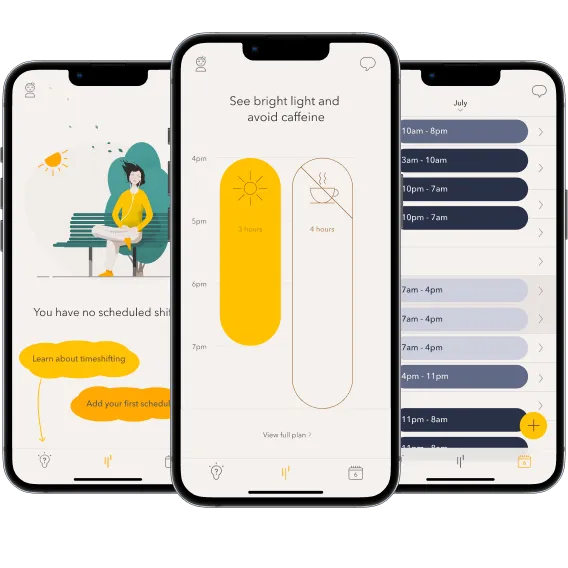
The shift work app that improves sleep and alertness, personalized to your schedule.